Nicholas of Flüe
A peasant, judge and father of ten, he went to live at the bottom of a ravine — and the Confederation came there to consult him.
- Middle Ages
- Switzerland
- Feast day March 21
- 1417 – 1487
- Hermit
- Mystic
- Confessor
He was first everything a man can be in a valley of Obwalden: a well-off farmer, an officer in the Zurich war, husband of Dorothea Wyss, father of ten children, councillor of the canton, judge of his commune for nine years. As a judge he detested procedure and pressed for settlements; it is told that a vision of flames coming from the mouth of an unjust judge made him give up the office. In October 1467, with his wife's consent, he left the house too — the last child was under a year old, the eldest was twenty. He set out towards the Rhine, turned back, and settled in the ravine of the Ranft a few minutes from his home, where he had a chapel served by a priest he paid, so as to hear Mass daily. He was consulted from far off: Archduke Sigismund sent him a gilded chalice, Milan its envoys, Bern and Solothurn their letters of thanks. In December 1481 the Confederation was on the point of breaking apart at the Diet of Stans; in the night of the 21st the parish priest of Stans climbed up to see him and came down with advice whose content no one has ever known. The delegates reconvened and came to agreement within two hours: the pact was renewed, and Fribourg and Solothurn admitted to the Confederation. He died on 21 March 1487 after a hard agony. Pius XII canonised him in 1947; he is the patron of Switzerland.
Recognising
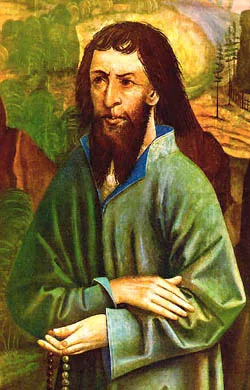
A gaunt bearded old man in hermit’s habit, staff in hand and a fifty-bead prayer cord — the Bätti of Alpine devotion, and not the Dominican rosary the century was then seeing spread. Sometimes the Sachseln meditation cloth with its six-spoked wheel.