Jerome of Stridon
A priest and Doctor of the Church, he is best known for translating the Bible from its original languages into Latin, a version known as the Vulgate.
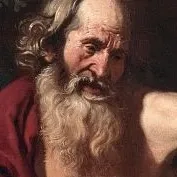
- Antiquity
- Croatia
- Feast day September 30
- c. 347 – 420
- Doctor of the Church
- Priest
- Monk
- Hermit
- Founder
Saint Jerome of Stridon, born around 347 in Stridon (likely straddling modern-day Croatia and Slovenia), was one of the most learned Church Fathers of Late Antiquity. He studied in Rome, where he received a classical education in grammar, rhetoric, and philosophy. After his baptism, he embarked on a spiritual journey that took him to Gaul, then to Antioch, where he learned Greek. His most formative period was undoubtedly his time as a hermit in the desert of Chalcis in Syria, where he dedicated himself to the study of the Scriptures and learned Hebrew, a rare language among Christian scholars of his time. Returning to Rome, he became secretary to Pope Damasus I, who entrusted him with the monumental task of revising the existing, often inconsistent, Latin translations of the Bible. This marked the beginning of the work that would become the Vulgate. After Damasus' death, Jerome left Rome to settle in Bethlehem, where he founded monasteries and continued his scholarly work until his death in 420. His translation of the Bible directly from Hebrew and Greek (the Old Testament from Hebrew, the New Testament from Greek) into Latin, known as the Vulgate, was his life's work. It became the official version of the Catholic Church for over a millennium and exerted invaluable influence on Western thought and culture. Jerome was also a prolific commentator on the Scriptures and a fervent defender of Christian orthodoxy, often engaged in theological controversies. He is venerated as one of the four great Latin Doctors of the Church, alongside Saint Ambrose, Saint Augustine, and Saint Gregory the Great.
Patronage
Sayings for the day — September 30
- Saint-Jérôme venu, sors ta charrue
- A la Saint Jérôme, hoche tes pommes
- A la Saint-Jérôme, garçon, il faut prendre de ta charrue des manchons.