Germaine Cousin
A disabled, ill-treated shepherdess, dead at twenty-two and canonised two and a half centuries later.
- Early modern era
- France
- Feast day June 15
- 1579 – 1601
- Virgin
- Confessor
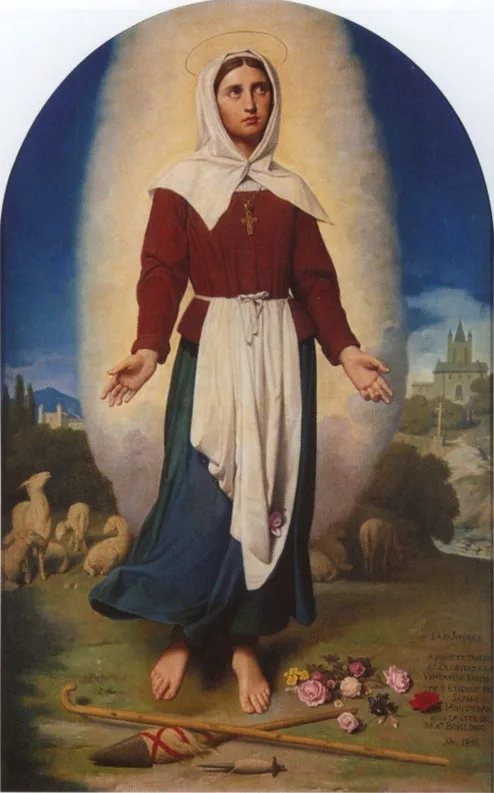
Born in 1579 at Pibrac near Toulouse to poor peasants, she came into the world with a withered right hand and suffered from scrofula. Her mother died while she was small; her stepmother kept her out of the house, making her sleep under the stairs and then in the sheepfold. She was given the flock, which she led alone into the fields, and spent her days outdoors, leaving her animals for daily Mass without one of them ever straying or being taken by wolves — something the villagers noticed before the Church did. Tradition holds that she shared what little bread she had with the poor, and that on a winter's day when she was accused of stealing it, her opened apron let nothing fall but flowers. She died in 1601, aged twenty-two, found one morning on her pallet. Her body, exhumed forty years later during work in the church, was found intact, and pilgrimages began. Pius IX canonised her in 1867.
Patronage
Recognising
A shepherdess with her crook, a dog and a few sheep about her; her apron gathered up and filled with flowers, and her right hand often left visible in its deformity.
Sayings for the day — June 15
- Soleil à la Sainte-Germaine, beau temps pour toute la semaine.