Honoratus of Amiens
A sixth-century Picard bishop whose name now means a street, a cake and a trade.
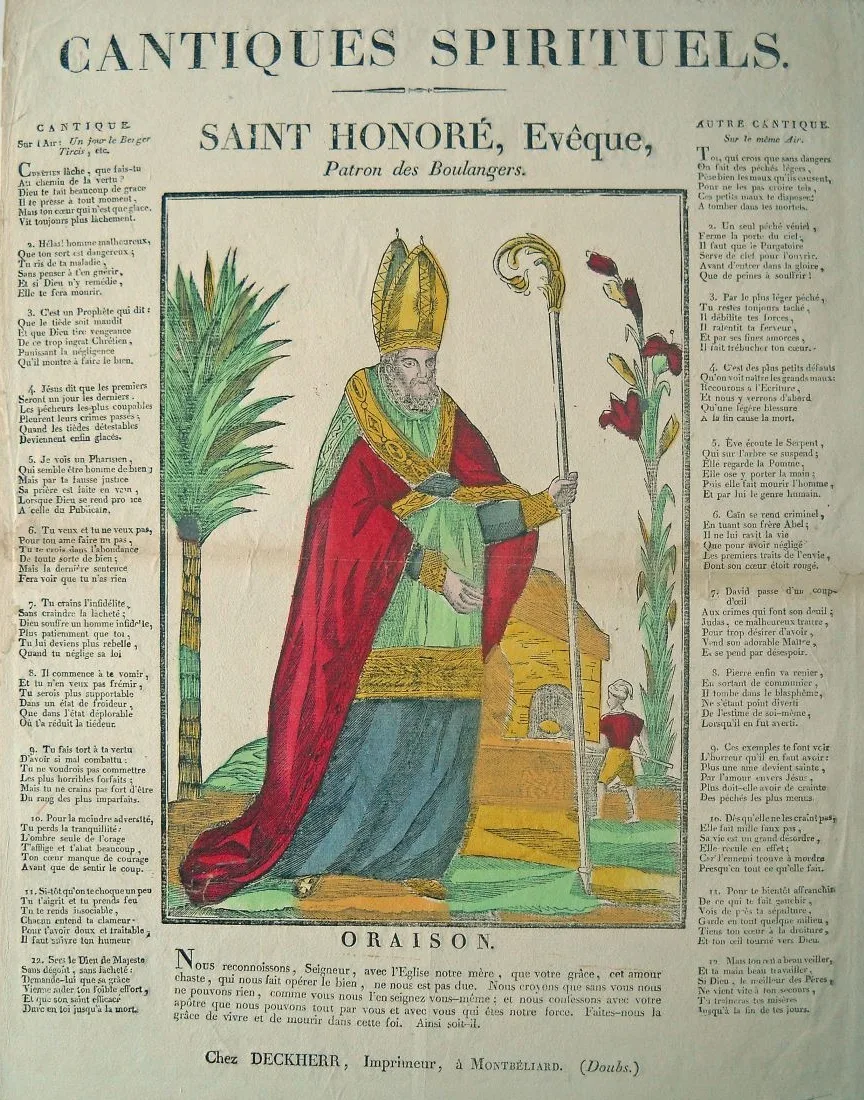
- Early Middle Ages
- France
- Feast day May 16
- c. 530 – 600
- Bishop
- Confessor
Born at Port-le-Grand in Ponthieu, he was the eighth bishop of Amiens in the second half of the sixth century. Almost nothing is known of his episcopate; it is his late legend that made his fortune. It tells that on the news of his election his nurse, busy at the oven, declared she would believe it only if the baker’s peel she held put out leaves — the peel became a mulberry tree, and the tree was shown for centuries. In the thirteenth century a Paris baker gave ground for a chapel in his name; the bakers' guild took him as patron, the street took the chapel's name, and a pastry-cook of that street invented in the nineteenth century the cake that still bears it. Few saints have left so concrete a trace on so slight a record.
Patronage
Recognising
A bishop holding a baker’s peel, often loaded with three loaves; sometimes the miraculous mulberry behind him.
Sayings for the day — May 16
- À la mi-mai, queue de l’hiver ; saint Honoré, que de pois verts.